
Integrated
Explore the immersive feel of a virtual world
Lorem ipsum dolor sit amet, consectetur adipisicing elit, sed do eiusmod tempor incididunt ut labore.
Founder | Max AI Holdings Inc.
Optimization is Becoming the Control Layer
Most organizations believe they control their systems.
In reality, control is shifting to the layer that determines outcomes.
I work at the intersection of cybersecurity, operational technology, and artificial intelligence—where that shift is already underway. We don’t implement tools.
We define how decisions are made inside systems.
The Shift is Already Happening
a structural change in How systems operate
Digital and physical systems are no longer defined solely by what they execute. They are increasingly defined by what they decide.
Optimization, once treated as a feature, has evolved into a continuous, embedded layer that shapes outcomes across interconnected environments.
- Decisions are no longer static
- Systems are no longer isolated
- Control is no longer where most organizations think it is
This shift is happening quietly, but its implications are significant.
This is the shift most organizations have not fully recognized.
“Control is no longer defined by who owns the system.
It is defined by what determines the outcome.”
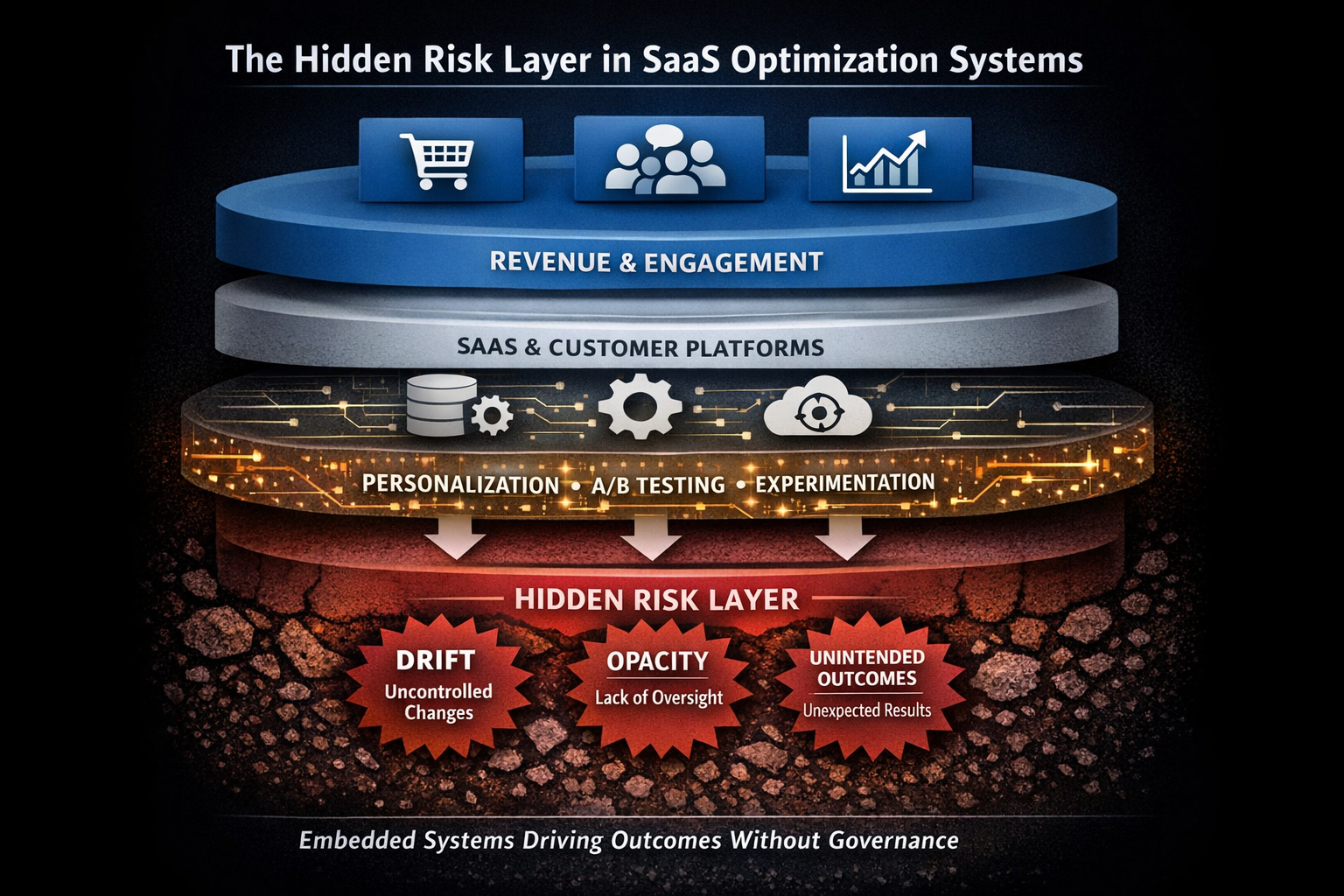
Systems are increasingly driving outcomes without corresponding governance.
That mechanism — the logic, the models, the optimization engines making those decisions — is what we call the Control Layer.
It is the layered architecture behind modern digital platforms and the often-overlooked risks embedded within them.
At the surface, organizations focus on revenue and engagement, driven by SaaS and customer-facing platforms. Beneath that, optimization mechanisms—such as personalization, A/B testing, and continuous experimentation—operate as the engines shaping outcomes in real time.
However, below these visible layers lies a hidden risk layer.
This layer represents the unintended consequences of continuous, automated decision-making systems.
The organizations that recognize this shift early will define the next era of leadership.
They will not just deploy intelligent systems —
They will govern how those systems decide.
The Control Layer
For decades, systems were built to execute.
- They followed instructions.
- They processed transactions.
- They did exactly what we told them to do — nothing more, nothing less.
Control lived with people. That world is gone.
Simulate your physical presence in a virtual environment. Lorem ipsum dolor sit amet, consectetur adipisicing elit, sed do eiusmod tempor incididunt ut labore.
Lorem ipsum dolor sit amet, consectetur adipisicing elit, sed do eiusmod tempor incididunt ut labore et dolore magna aliqua. Ut enim ad minim veniam, quis nostrud exercitation ullamco laboris nisi ut aliquip ex ea commodo consequat.
Velit aliquet sagittis id consectetur purus ut faucibus. Nulla malesuada pellentesque elit eget gravida cum sociis. Arcu ac tortor dignissim convallis aenean et tortor at risus.
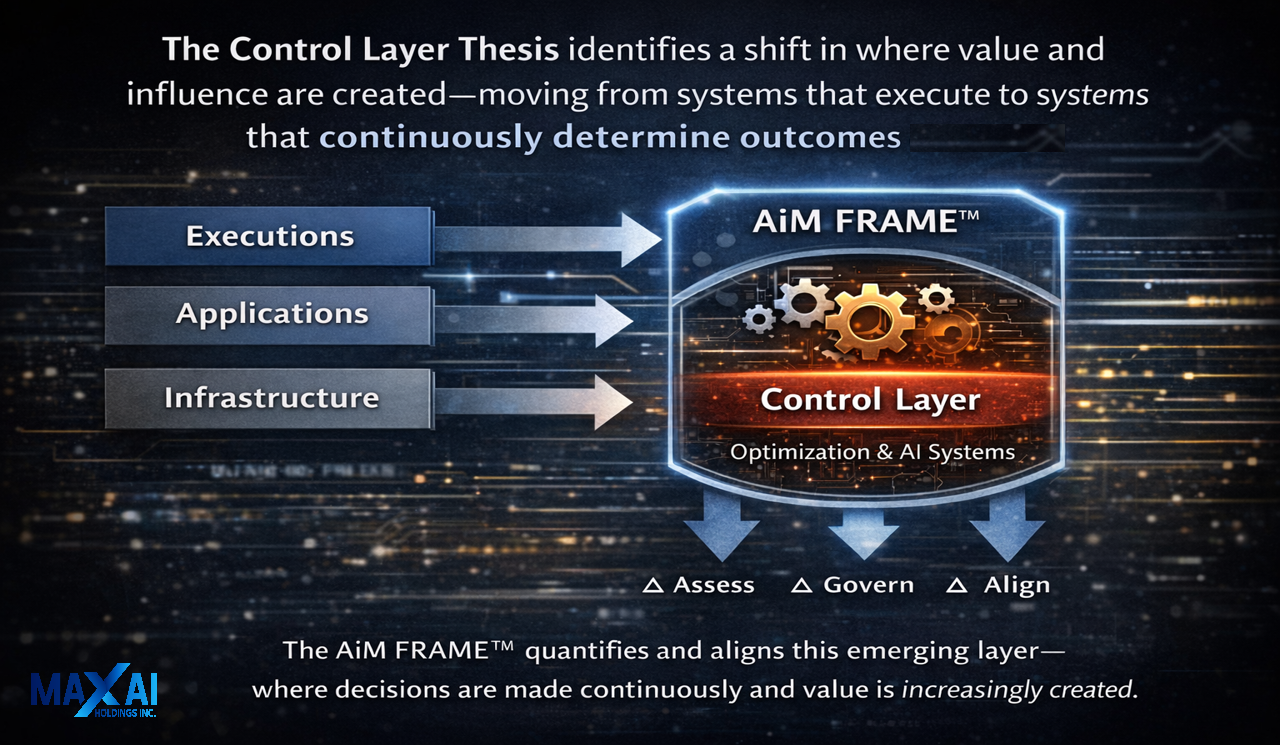
The Control Layer Does Not Sit On The Surface.
It operates quietly, embedded across platforms, infrastructure, and services.
It learns.
It adapts.
It refines outcomes over time.
And in doing so, it begins to shape behavior — not just inside systems, but across organizations.
This is where value is now created. And it is also where risk is now concentrated.
Because when systems begin to determine outcomes, the question is no longer:
“Is the system working?”
The question becomes:
“Is the system deciding correctly — and who is accountable if it isn’t?”
Most organizations cannot answer that question today.
They have invested in AI.
They have deployed optimization. But they have not established control.
The result is a growing gap:
Between what systems are doing… And what organizations believe they are doing.
That gap is where failure occurs. Quietly at first.
Then all at once.
CEO, MAX AI Holdings Inc.
THE CONTROL LAYER THESIS
Most organizations believe they control their systems.
They invest in infrastructure, deploy applications, define workflows, and assign responsibility to people and teams. Control, in this traditional view, is something that is designed, implemented, and managed within clearly defined boundaries.
For a long time, that assumption held. But it no longer does.
A structural shift is underway. It’s quiet, largely unrecognized, but increasingly consequential. Systems are no longer defined solely by what they execute. They are becoming defined by what they decide.
Across digital platforms and physical environments, a new layer has emerged. It does not sit neatly within any single application, nor is it owned in the conventional sense. It operates across systems, continuously evaluating conditions, selecting actions, and adjusting behavior in real time.
This is the control layer.
It began as something modest. Optimization was once a supporting capability—a way to improve performance, test variations, or refine outcomes at the margins. A/B testing frameworks, personalization engines, and rule-based decision systems were introduced to enhance efficiency and increase effectiveness.
But over time, these systems evolved. They became persistent. They became interconnected. And most importantly, they became continuous.
What was once periodic experimentation has transformed into always-on decision-making. Systems no longer wait for human input to determine what happens next. They evaluate, select, and act—repeatedly, and at scale.
The implication is subtle but profound.
Control is no longer located in the systems that execute tasks. It is migrating to the systems that determine which tasks are executed in the first place.
This distinction matters. Execution follows instruction. Decision determines direction.
And direction is where control resides.
Today, this shift is already visible in environments where outcomes matter most. Digital platforms rely on continuous optimization to shape user experience and drive revenue. Infrastructure systems increasingly incorporate AI-driven decision support to manage performance and efficiency. Operational environments—particularly those tied to physical systems—are beginning to integrate feedback-driven mechanisms that influence real-time behavior.
In each case, the same pattern emerges: the system that decides begins to matter more than the system that executes. Yet most organizations continue to operate as if control remains where it has always been.
This creates a gap.
Decisions are being made in places that are not fully understood, not consistently governed, and not always visible. Outcomes are influenced by systems that adapt over time, often without clear attribution. Authority becomes diffuse, even as impact becomes more concentrated.
In critical environments, this is not simply a technical issue. It is a question of resilience, security, and trust.
When systems begin to decide, governance must evolve. But governance is only part of the story. There is also a strategic dimension.
As this control layer becomes more embedded, it creates a new form of dependency. Systems that rely on continuous optimization cannot easily revert to static operation. The ability to adapt, refine, and respond in real time becomes integral to performance.
Over time, this layer becomes difficult to isolate, difficult to replace, and increasingly central to how outcomes are shaped.
This is where leverage begins to form.
The organizations that recognize this shift early will not simply improve their systems. They will understand where control is actually exercised. They will identify the points at which decisions are made, not just where actions are executed. And they will begin to align governance, strategy, and investment with this new reality.
Those that do not will continue to operate under assumptions that no longer hold.
They will secure infrastructure but overlook decision pathways. They will manage applications but miss the mechanisms that shape outcomes. They will believe they are in control, even as control moves elsewhere.
This is not a future scenario.
It is already happening. The question is not whether this shift will occur. It is whether it will be recognized in time to respond to it.
Because in the environments now taking shape, control is no longer defined by ownership of systems. It is defined by the ability to influence outcomes.
And that ability is moving.
Our Gallery






Multi-projected environments

Lorem ipsum dolor sit amet, consectetur adipisicing elit, sed do eiusmod tempor incididunt ut labore et dolore magna aliqua.
Ut enim ad minim veniam, quis nostrud exercitation ullamco laboris nisi ut aliquip ex ea commodo consequat. Velit aliquet sagittis id consectetur purus ut faucibus.
Velit aliquet sagittis id consectetur purus ut faucibus. Nulla malesuada pellentesque elit eget gravida cum sociis. Arcu ac tortor dignissim convallis aenean et tortor at risus.
Velit aliquet sagittis id consectetur purus ut faucibus. Nulla malesuada pellentesque elit eget gravida cum sociis. Arcu ac tortor dignissim convallis aenean et tortor at risus.
Velit aliquet sagittis id consectetur purus ut faucibus. Nulla malesuada pellentesque elit eget gravida cum sociis. Arcu ac tortor dignissim convallis aenean et tortor at risus.
Velit aliquet sagittis id consectetur purus ut faucibus. Nulla malesuada pellentesque elit eget gravida cum sociis. Arcu ac tortor dignissim convallis aenean et tortor at risus.
Velit aliquet sagittis id consectetur purus ut faucibus. Nulla malesuada pellentesque elit eget gravida cum sociis. Arcu ac tortor dignissim convallis aenean et tortor at risus.
Robot navigation, construction modeling, and airplane simulation
Lorem ipsum dolor sit amet, consectetur adipisicing elit, sed do eiusmod tempor incididunt ut labore et dolore magna aliqua.
Ut enim ad minim veniam, quis nostrud exercitation ullamco laboris nisi ut aliquip ex ea commodo consequat.
Velit aliquet sagittis id consectetur purus ut faucibus. Nulla malesuada pellentesque elit eget gravida cum sociis. Arcu ac tortor dignissim.

Virtual Insights
Lorem ipsum dolor sit amet, consectetur adipisicing elit, sed do eiusmod tempor incididunt ut labore et dolore magna aliqua.
Generate realistic images, sounds and other sensations
Lorem ipsum dolor sit amet, consectetur adipisicing elit, sed do eiusmod tempor incididunt ut labore et dolore magna aliqua.